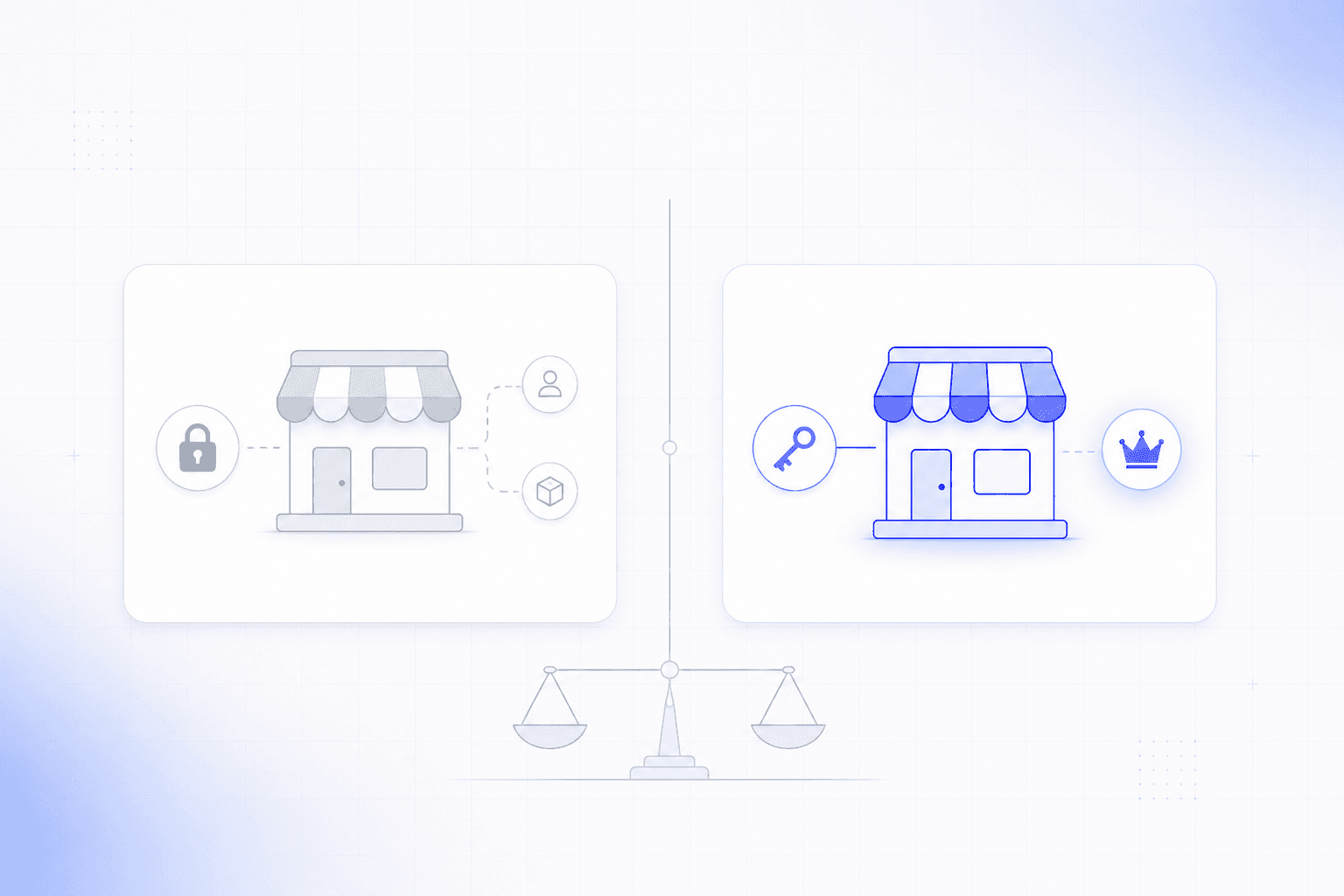
Rimo vs Wheel live test


If you searched "Rimo vs Wheel," you already know something is wrong. Here is exactly what it is costing you, and why the lock-in is structural, not contractual.
Most operators who type "Rimo vs Wheel" into a search bar are not doing early-stage research. They have already built something real: a patient base, a rebill stack, a brand with a name on it. The search happens later, when something starts to feel wrong, and they need a word for it. That word is ownership, and most operators don't fully name it until they try to act like they have it. See our white label telehealth platform for how this works in practice.
Wheel - The Hidden Cost of Surrendering the Merchant Account
The common assumption among telehealth brands built on powered-by platforms is that if Wheel has the providers and the infrastructure, surrendering the merchant account and patient data is just the cost of doing business in telehealth. It is a cost they inherited without knowing it.

The frustration arrives quietly. A platform policy shifts. A revenue-share tier resets.
Someone on the team asks, "Can we just export our patient list?" and the answer comes back slower than it should. That is the moment the comparison tab opens, and it is not routine due diligence.
It is a distress signal wearing the costume of research. An operator builds 300, 400, 500 active customers on a white-label platform. Rebills are firing.
Revenue is real.
Then they try to do something that any business owner should be able to do, move, negotiate, or simply understand the infrastructure under their brand, and they hit a wall they did not know was there. The gaps that make leaving so hard are structural. As ACI Worldwide explains, payment tokens are non-transferable between merchant accounts by design.
For an operator with 400 active rebills, this means every recurring billing relationship breaks to zero the moment they try to migrate. The platform also holds the merchant ID, the token vault, and every stored payment credential. The operator is a sub-merchant at best, with no portable billing history.
Rimo - Operator Ownership Structured In from Day One
A search for "Rimo vs Wheel" names two specific platforms, which means the searcher already knows the category, already has context, and is already measuring against something they are currently experiencing. This is a late-stage signal. The operator is evaluating whether to leave where they are.
One operator described the alternative plainly: "Launchpad with OpenLoop is a little limiting. It looks great, but you can't make any edits."
That sentence captures the whole problem in one breath.
The three structural gaps that make migration so costly are:
- Patient data, export timelines, and intake histories live inside the platform's architecture, not the operator's.
- Teleform configurations are locked to the platform, making extraction technically complex and time-consuming.
- The cost of extracting any of it is high enough that many operators treat migration as functionally impossible.
That feeling of impossibility is the lock-in working exactly as designed. Rimo's model addresses all three at the structural level, making the operator the merchant of record from day one, so card tokens, patient data, and the rebill engine belong to the brand before the first subscription ever fires. The ownership gap compounds in dollars, month over month, rebill over rebill, and the number gets uglier the more successful the brand becomes.
The Hidden Cost of Wheel's Model - Revenue Share, Token Lock, and the Rebill Cliff
At 500 active customers, a 10% revenue-share arrangement costs a telehealth brand $15,000 every month in platform fees. Rimo's flat Enterprise plan runs $5,000. That $10,000 monthly gap is a structural feature of how percentage-based models work, and it gets worse every time you succeed. The common assumption among telehealth brands stuck on powered-by platforms is that if the platform has the providers and the infrastructure, surrendering the merchant account and patient data is just the cost of doing business in telehealth. The math below shows exactly how much that assumption costs at scale.
The Grand View Research Telehealth Services Market Report projects the global telehealth market will grow from $103.5 billion in 2026 to $291.4 billion by 2030 at a 30.2% CAGR. As your GMV scales in line with the market, the absolute dollars surrendered to a revenue-share intermediary scale with it. The fee is never a fixed line item you budget around once. It is a percentage claim on every dollar of growth you generate.

The Revenue-Share Math That Gets Worse Every Time You Win a Patient
A brand running 500 active customers at roughly $300 per customer per month generates approximately $150,000 in monthly GMV. At a 10% platform cut, that is $15,000 gone before payroll, before ad spend, before pharmacy costs. At $5,000 flat, the same operator keeps an additional $120,000 per year and retains full margin visibility. Scale to 1,000 customers and the gap doubles. The revenue-share model grows with your revenue, which means your best months are also your most expensive ones.
Card Token Non-Portability, Why Every Rebill You've Built Is Stranded
Card tokens are cryptographically bound to the originating merchant account. This is how payment processors including Stripe, NMI, and Authorize.net architect tokenization. A token generated inside one merchant account cannot be decrypted or re-used inside a different one. When you migrate off a platform that holds the merchant account, every saved payment method your recurring customers stored breaks overnight.
For a brand with hundreds of active subscriptions, that is a churn event dressed up as a technical constraint. Rimo's model removes this exposure at the foundation: revenue settles directly to the brand's own merchant account from day one, so the tokens belong to the operator, not the platform.
The LegitScript Myth That Keeps Operators Frozen on the Wrong Platform
The belief that LegitScript certification is tied to a specific platform, and that switching means restarting the full certification process, is widely cited as a migration barrier. According to industry data published in the certification FAQ, the certification attaches to the brand entity, not the underlying technology infrastructure, meaning a platform change typically does not trigger a full re-review from scratch, though operators should notify LegitScript of infrastructure changes and confirm their specific scope before migrating. LegitScript certifies the brand, not the infrastructure it runs on, so transferring certification when a brand moves platforms does not automatically trigger a full re-review from scratch.
The costs above are not hypothetical; they are the exact variables that separate two operators running identical patient volumes with radically different margins and exit valuations. The next section runs both platforms through the same live scenario so you can see precisely where the lines diverge.
Rimo vs Wheel Live Test - Ownership, Pricing, and Portability Side by Side
Four structural facts separate these two platforms, and none of them show up in a feature checklist. Operators who treat the Rimo vs Wheel comparison as a capability audit are asking the wrong question. The real question is: when a rebill fires at 11 p.m. six months from now, whose merchant account processes it, whose data sits in the vault, and whose business just got more valuable?

Merchant of Record - Who Actually Owns the Payment Rail When a Rebill Fires
Choosing Wheel's rails doesn't just mean paying a revenue share, it means permanently surrendering your patient rebill engine, because payment tokens are legally non-transferable between merchant accounts by design.
Even if you later negotiate a better deal or migrate to a new platform, you cannot bring your recurring billing relationships with you: every patient would have to re-enter their card details from scratch, creating a churn event at the exact moment your business is trying to grow.
This is card-network architecture, not a contract clause a good lawyer can negotiate around. The moment a patient's card is tokenized under a platform's merchant ID, that token belongs to that merchant account permanently. If the operator later migrates, every recurring patient must re-enter payment details from scratch, creating a churn event precisely when the business is trying to accelerate.
Operators who migrate off an affiliate or revenue-share platform and finally take ownership of their brand, merchant account, and patient data describe the token problem in the same words: "You can't pull over tokens." This is a permanent, irrecoverable loss of the billing relationships you spent months building.
Rimo operates on a net account from day one, so every token issued is issued under the operator's merchant ID. The rebill engine, the payment relationships, and the recurring revenue are the operator's assets, not infrastructure they are renting. Rimo's in-house rebill engine and subscription management sit inside that same operator-owned account, so the recurring revenue stack never touches a rail the operator does not control.
Flat Fee vs Revenue Share - Where the Pricing Curves Cross and Diverge
The crossover happens faster than most operators expect. Take a brand with that same figure active patients generating roughly $150,000 in monthly GMV: at a 10% revenue-share arrangement, the platform takes $15,000 that month. Rimo's Enterprise plan, designed for HRT, specialty medications, and white-glove support, costs a flat $5,000 per month with no revenue share, no per-patient fee, and no transaction fees. At that same figure active patients, the flat-fee operator is already ahead.
Scale to 2,000 patients and GMV reaches approximately $600,000. The revenue-share bill climbs to $60,000 monthly, while the operator on Rimo's Enterprise plan pays $5,000 flat, as Fuse Health's 2025 breakdown confirms. The gap compounds every month.
By month 12 at that volume, the cumulative difference is extraordinary. That is not a rounding error; it is a hiring decision, a paid-media budget, or retained equity in a business you might one day sell. Keeping ownership of the customer and the economics is what makes that equity real, and a flat-fee model with no revenue share is the structural prerequisite for it.
One cost layer operators often overlook is consultation fees. Rimo passes these through at cost with no platform markup: GLP-1 consults run $30 per consult and a single prescription covers six months; non-GLP-1 consults (ED, hair, derm, peptides) run $18 per consult with Rx windows of 6 to 12 months. Operators who bring their own contracted prescribers have those consultation fees waived entirely. The only other threshold worth planning for is LegitScript certification, a one-time that same figure expedited fee that covers all associated costs and completes in 7 to 14 days, handled end to end by Rimo so the operator never has to manage the filing process themselves.
Patient Data and Teleform Control - What You Can Edit, Export, and Take With You
Owning the intake surface matters more than operators realize until they try to change it. The inability to edit a teleform means the operator cannot test conversion copy, cannot add a new intake question for a new product line, and cannot respond to a compliance update without waiting on the platform's roadmap.
Fuse Health's 2025 analysis documents that Rimo operators can edit their own teleforms, export all patient records, and complete that export within 24 hours. Full ownership of brand, merchant account, and patient data is a stated design commitment of the platform. That portability window matters most during a platform transition, an acquisition due-diligence process, or a regulatory audit.
A buyer evaluating a telehealth brand will discount heavily if the patient records live in a system the seller does not control. Data portability is exit value.
Operators who have come from affiliate-model platforms, where the brand, the merchant account, and the patient data all belonged to someone else, recognize immediately what they were giving up before they made the switch.
Live-in Timeline Head-to-Head: 2 Weeks vs the Build-It-Yourself Clock
Rimo's live-in timeline is 2 to 2.5 weeks from contract to launch, according to Fuse Health's 2025 platform review. That timeline is possible because the operator connects their own payment processor, inherits existing pharmacy rails with 24-hour turnaround, same-day ship, and next-day air, and configures rather than builds. The provider network covers all 50 states, and operators can layer in their own providers, so the clinical infrastructure is ready at launch, not assembled over months. LegitScript certification, a step that typically stalls self-built brands for weeks, is handled end to end by Rimo within the same 7-to-14-day window, eliminating one of the most common launch blockers entirely.
The honest trade-off: operators who need deeply custom clinical workflows or proprietary prescriber networks may find a flat-fee white-label platform constraining compared to a fully bespoke build. For most D2C telehealth brands launching a subscription product, though, the 2-week path on a platform that keeps the operator in the merchant seat, owning the brand, the billing rail, and every patient record, is the faster route to a business they actually own.
The ownership gap between these two platforms mirrors a much older confusion in the language operators use every day, one worth resolving before it quietly shapes the wrong decision. The next section untangles exactly that.
Wheel vs Rim Terminology Explained - What Each Term Actually Means
Rim vs. Wheel Explained, The Terminology Difference That Reveals What 'Powered-By' Platforms Keep
The rim is the part everyone points to. It is the shiny outer edge catching light in the driveway, the piece a car enthusiast means when talking about new wheels. But calling a rim a wheel is like calling a doorframe a house. The distinction is structural, and getting it wrong costs real money.

"Users confuse 'rim width' and 'tire width' as interchangeable concepts, leading to misdiagnosis of their own setup (e.g. one user believed they had 'different width rims' when they actually had different width tires)."
— what we hear from cycling or automotive enthusiasts
One of the most consistent conceptual gaps beginners carry into this space is mistaking the visible outer piece for the full assembly, conflating which specific component attribute actually drives performance. Beginners routinely misread their own setup because of it: they diagnose the wrong part, order against the wrong spec, and end up with components that seat incorrectly. The terminology gap cascades into every downstream decision.
A Wheel Is the Complete Assembly
A wheel is the complete circular metal assembly that bolts directly to the vehicle's axle or hub, bearing the full load of the vehicle across every road condition. According to The Engineering Choice's breakdown of car wheel parts, a wheel comprises four distinct components working together:
- the hub (the central mounting point that attaches to the axle)
- the spokes (structural connectors between hub and barrel)
- the barrel (the cylindrical body that gives the wheel its width and depth)
- the rim (the outermost edge that interfaces with the tire)
Remove any one of those four and the assembly fails. The hub is where the load transfers. The barrel sets the offset. The spokes carry the tension. None of that is visible once a tire is mounted. The Engineers Post reinforces this point: the load-bearing integrity of the full wheel lives in the components hidden beneath the tire, not in the rim face a buyer evaluates in a showroom.
The Rim Is Only the Outer Edge
The rim is one specific structural component nested inside the wheel assembly. The Engineering Choice defines it precisely: the rim is the outermost edge or lip of the wheel, the part that contacts and secures the tire bead, maintains an airtight seal, and includes the flanges and bead seat that hold the tire in place. That is its entire job.
It does not bear axle load. It does not determine offset or backspacing. Operators ordering UTV replacements who specify "rim size" when they mean barrel width routinely receive parts that seat incorrectly, because bead seat diameter and barrel width are different measurements on different components. A parallel confusion surfaces constantly among beginners: conflating rim width and tire width as interchangeable concepts, then misdiagnosing their entire setup as a result. The rim does its one job well. It cannot do the hub's job at all.
What the Rim-vs-Wheel Distinction Reveals About 'Powered-By' Platforms
A rim is the outermost visible edge of a wheel, the part everyone sees, but it cannot function without the hub, spokes, and barrel beneath it. The telehealth company named Wheel is structurally identical to that rim, delivering the visible patient-facing clinician layer while retaining the hub, the merchant account, card token vault, patient data pipeline, and rebill engine inside its own infrastructure, hidden under the tire.
This is the confusion that costs telehealth operators real equity. Beginners we work with frequently misread "powered-by" arrangements the same way a buyer misreads rim width as tire width: they believe they own the setup because their brand name is on the patient portal, when what they actually own is the face, the rim, while the platform keeps the hub. The merchant account is not theirs. The card tokens are not theirs. The patient records live in someone else's infrastructure. When they want to migrate, there is nothing portable to take.
A white-label telehealth platform that makes the operator the merchant of record puts the hub in the operator's hands: the card tokens, the patient records, the rebill relationships. Rimo is built on that principle; full ownership of brand, merchant account, and patient data transfers to the operator, not the platform. The in-house rebill engine and subscription logic run inside that operator-owned structure, which means the rebill relationships are an asset the brand can take, sell, or migrate.
The Growth plan ships the complete assembly, full white-label platform, provider network, pharmacy rails, payments, and portal, not a rim branded to look like a wheel, even though Wheel does offer white-label experiences to clients. The Enterprise plan adds HRT catalog access and specialty medications for brands scaling into more complex clinical categories, again with the same full-ownership architecture underneath.
Operators who come to Rimo after an affiliate or "powered-by" arrangement are not starting over; they are migrating off a rim and finally installing a complete wheel. The hub moves into their hands. So does everything attached to it.
The terminology gap between wheel and rim is a naming problem. The terminology gap between Rimo and Wheel is an ownership problem. Ownership is the variable that determines whether your telehealth brand is a sellable asset or a rented seat at someone else's table.
Why Becoming Merchant of Record Is the One Decision That Makes Your Telehealth Business Sellable
Most telehealth operators building on a powered-by platform assume their ARR is theirs. It is not, and the mechanism that makes it someone else's is not a contract clause you can negotiate away but a structural reality baked into how card tokens and merchant accounts work. This section breaks down exactly where that ownership gap lives, why it surfaces as a valuation problem the moment a serious acquirer opens your books, and what it means for operators who want to build something they can actually sell.

Card Token Portability Is the Hidden Tripwire in Every Platform Migration
Card tokens are not a payment detail. They are the physical embodiment of every recurring revenue relationship you have built, and the card-network architecture that mints them makes them non-transferable by design. An operator generating $2M ARR on a powered-by platform cannot simply "move" that revenue. The ARR moves only if the tokens move, and the tokens cannot move.
The failure point is structural, not operational. When a platform holds the merchant account, the card tokens are vaulted under that platform's processor credentials. Migrating off means those tokens stay behind.
Every subscriber who doesn't re-enter payment details is a cancelled rebill, and what most teams report from forced re-authorization events consistently shows that a significant share of customers never complete the re-entry step. Visa's account-updater program documentation notes that passive card-on-file attrition can reach 20-30% when stored credentials must be manually re-entered, because friction at billing is attrition. That's not a migration inconvenience. That's an overnight reset of your entire recurring revenue base.
Why Acquirers Discount ARR That Lives Inside a Vendor Relationship
Sophisticated acquirers treat this as a structural defect, not a line-item risk. Across the market, SaaS due diligence frameworks consistently flag that revenue depending on a third-party vendor relationship rather than a directly owned merchant account introduces concentration risk that can reduce valuation or kill a deal entirely. Buyers assess whether customer payment tokens and subscription data are portable and transferable, or locked inside a platform. When they're locked, the ARR isn't auditable as standalone revenue. It's a vendor-dependent cash flow, and buyers price it accordingly.
The 24-Hour Full-Export Standard - What "Always Sellable" Actually Requires
A telehealth business is genuinely sellable when its card tokens, patient records, and intake configurations are exportable on demand, independent of the platform's continued goodwill. L40's acquisition checklist states plainly that platform dependencies preventing data portability represent material risks that can block a transaction entirely. The standard that satisfies M&A diligence is a full data export in 24 hours or less, covering every asset the acquirer needs to operate the business without the original vendor.
Rimo's white label telehealth platform resolves this from day one: operators hold their own Stripe, NMI, or Authorize.net merchant account, card tokens vault under their credentials, and a complete data export ships within 24 hours on request. The merchant-of-record decision is binary. You either own the rails your revenue runs on, or you don't, and the cost of not owning them compounds silently until the moment you try to move.
Next steps
If your recurring revenue is compounding on rails you do not own, the path forward starts with recognizing that the merchant-of-record decision is binary: you either hold the hub or you rent it, and renting it gets more expensive with every patient you add. Start with our white label telehealth platform.
Revenue-share pricing that looks manageable at launch becomes your largest cost line by $5M GMV, accelerating in direct proportion to your growth. Card tokens are non-transferable between merchant accounts by design, which means every rebill relationship you have built on a powered-by platform is stranded the moment you try to move. Together, those two facts point to one action: get into your own merchant account before the token vault grows any larger and the migration cost rises with it.
Start with Rimo. From there, provider credentialing, pharmacy rails, Stripe whitelisting, and a full patient-data export window come with the setup, and the standard go-live timeline lands inside two weeks.
Key takeaways
- Operators searching 'Rimo vs Wheel' are rarely doing early research, they've already built a patient base and a rebill stack, and something has started to feel wrong.
- At 500 active customers, Wheel's revenue-share model costs a telehealth brand roughly $15,000 a month in platform fees before a single clinical dollar hits the founder's pocket.
- Card tokens are non-transferable by card-network design, migrate off a powered-by platform and every recurring billing relationship you built breaks the same night.
- Becoming merchant of record isn't a technical upgrade; it's the structural decision that makes a telehealth business sellable, because ARR tied to someone else's merchant account doesn't transfer in an acquisition.
- LegitScript certification and a live rebill stack can both survive a platform migration, the fear that they can't is what keeps most founders frozen longer than the economics justify.
- Rimo closes the loop by making the brand the merchant of record on its own processor (Stripe, NMI, or Authorize.net), patient data, card tokens, revenue, and retail pricing stay with the brand, everything exports in 24 hours, and there's no vendor lock-in keeping the business unsellable.
Frequently asked questions
- Is a wheel the same as a rim?
- No, a rim is just the outer edge of the wheel assembly, not the complete unit. The post describes calling a rim a wheel as "like calling a doorframe a house," and warns that conflating the two leads to diagnosing the wrong part and ordering against the wrong spec.
- If I migrate off my current platform, can I take my patient rebill relationships with me?
- No, card tokens are cryptographically bound to the originating merchant account and cannot be transferred to a different one by design. If your current platform holds the merchant account, every recurring patient would have to re-enter their payment details from scratch when you migrate, creating a churn event at the worst possible moment.
- At what customer volume does a flat-fee platform start saving money over a revenue-share arrangement?
- The crossover happens faster than most operators expect. The post shows that at 500 active patients generating roughly $150,000 in monthly GMV, a 10% revenue-share arrangement costs $15,000 per month versus a $5,000 flat Enterprise fee, meaning the flat-fee operator is already $10,000 ahead each month at that scale.
- Does switching platforms mean I have to redo my LegitScript certification from scratch?
- Not automatically. LegitScript certifies the brand entity, not the underlying technology infrastructure, so a platform change typically does not trigger a full re-review from scratch, though operators should notify LegitScript of infrastructure changes and confirm their specific scope before migrating.
- How quickly can I actually go live on Rimo?
- Rimo's live-in timeline is 2 to 2.5 weeks from contract to launch. That window includes connecting your own payment processor, inheriting existing pharmacy rails, and having LegitScript certification handled end to end by Rimo within the same 7-to-14-day period.
Start with Rimo
From there, provider credentialing, pharmacy rails, Stripe whitelisting, and a full patient-data export window come with the setup, and the standard go-live timeline lands inside two weeks.